Fair Housing Act accommodation for emotional support animals
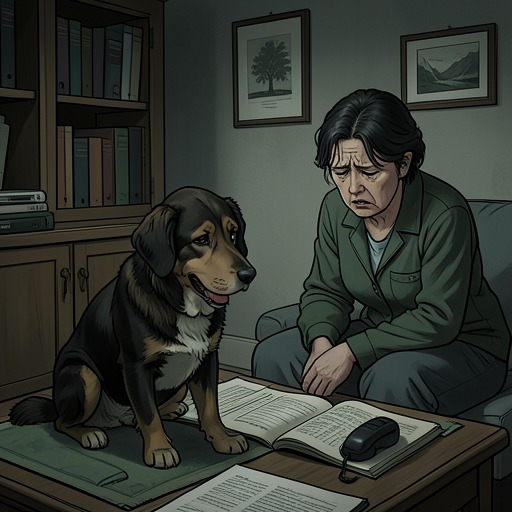
A Dog's Way HomeThe Fair Housing Act accommodation for emotional support animals is the legal route Dr. Sterling identifies for keeping Bella in Lucas and Terri’s no-pets building. Its importance in the story lies in the gap between care that is already happening and recognition that must be formally documented: Bella helps Terri and comforts people at the VA hospital, but neither role automatically settles where she may live or go. The discussion distinguishes a possible housing accommodation from permission to bring an animal onto hospital premises.
The rule and its limits
Dr. Sterling explains that seizure dogs exist and that many are trained to give signals of an impending seizure. Bella, by contrast, is not described as trained or certified. He tells Lucas that, in his understanding of the law, a doctor-prescribed seizure dog must be allowed even in a no-pet building, while cautioning that Bella would have to be certified before she could be treated as one. Until then, she is legally just a pet for the purposes of the discussion. He also acknowledges that claims about seizure dogs saving lives have supporters and doubters; the conversation does not present Bella’s behavior as established medical proof.
The alternative Dr. Sterling offers is narrower and more immediately available. He says that, as he understands the Fair Housing Act, a letter from a doctor currently treating Terri is all that is required for Bella to be considered an emotional support animal. He writes the letter, giving Lucas a concrete document to use in seeking an exception to the apartment no-pets clause. When Lucas asks whether the letter will let them stay, Dr. Sterling answers cautiously: what he has read online seems to imply that the building must allow it, but he is not an attorney. The protection is therefore presented as a plausible housing accommodation, not as a guarantee that every dispute is resolved on the spot.
Bella’s care and the question of recognition
The need for a formal category emerges alongside scenes in which Bella’s supportive role is already evident. At the VA hospital, Ty takes her to rooms where people welcome and pet her, even though there are no dogs there. Lucas worries that Dr. Gann may learn she is present; Ty responds that they can probably keep her out of sight for a couple of hours. Bella’s visit shows that people value her company, but it also shows the difference between being welcomed by individuals and being permitted under an institution’s rules.
Mack, whom Ty introduces to Bella, is deeply sad. Bella responds by climbing into his chair to be close to him, and Mack hugs her. The scene makes comfort an action rather than merely a label: Bella notices distress and stays with the person who needs her. It gives human meaning to the discussion of emotional support, although the story does not treat this moment as a formal assessment or certification.
Terri’s seizures create a related but distinct question. Lucas reads that fifteen percent of dogs can sense seizures, and Terri agrees that Bella seemed to know what was happening. Lucas says Bella barked on both recent occasions when Terri was going into a seizure, and that recognizing the warning could have helped them prepare. This is the basis for his interest in seizure-dog status, but Dr. Sterling cannot confirm Bella’s eligibility on that evidence. The distinction matters: Lucas’s observations motivate the request, while the procedure and the doctor’s letter determine what can be claimed formally.
Housing accommodation versus hospital policy
Dr. Sterling explicitly separates the housing letter from the VA hospital’s rules. After preparing the letter, he warns that it is not a universal exemption: having Bella at the VA remains against the rules. He adds that a seizure dog might be treated differently, but an emotional support animal is barred there. The same animal can therefore be the subject of a possible accommodation at home and remain impermissible at work. The rule does not erase the institution-specific boundary between housing and hospital access.
That boundary gives the accommodation its practical stakes. Lucas is seeking a way for Bella to remain with him and Terri despite the building’s no-pets restriction, not a general license to take her everywhere. The letter responds to the housing problem; it does not resolve Bella’s status as a seizure-alert dog, nor does it override the VA’s separate policy. The story presents legal recognition as consequential but limited, dependent on the setting and on which of Bella’s roles is being invoked.
Significance
The exchange places everyday interdependence beside procedures of proof. Bella’s comfort of Mack and Lucas’s account of her warnings to Terri are experiences within the family and hospital community; the accommodation requires those experiences to be translated into a doctor’s letter and a legally relevant category. That translation offers a possible answer to the apartment restriction while leaving other rules intact.
The result is neither a simple victory nor a rejection of Bella’s importance. Dr. Sterling’s letter gives Lucas a credible next step, and his qualified explanation lets the reader see why an emotional support animal designation may matter even when seizure-dog certification is unavailable. At the same time, the warning about the VA prevents the housing rule from being mistaken for blanket access. In the story, the Fair Housing Act accommodation is a specific bridge between Bella’s place in Terri and Lucas’s life and the building’s restrictions, with clear limits beyond that home.